

CONGRUENT SOUL THERAPY
Therapy for the Parts of Life That Feel Harder Than They Look
You might be the person everyone counts on. The one who figures things out, anticipates what everyone needs, keeps things moving, and somehow remembers the seventeen things nobody else thought about.
You might also be exhausted.
Maybe your mind rarely quiets down. Maybe relationships seem to require more emotional energy than they should. Maybe you understand your patterns intellectually but still find yourself repeating them.
Or maybe you've spent so much time adapting to what other people need, expect, or understand that you're not entirely sure what you need anymore.
At Congruent Soul Therapy, we look beyond the presenting problem to understand the person experiencing it.
Our work considers the relationship between Self, Other, and Context: how you experience yourself, how you relate to others, and how your history and environment shape the way you move through the world.
Because sometimes the problem isn't simply that you need better coping skills. Sometimes we need to look at the whole picture.
What Would You Like to Understand Better?
You don't need to arrive knowing exactly what's wrong, what to call it, or which specialty applies to you.
These are some of the experiences and patterns we can explore together.
Anxiety & Overthinking
When your brain will not turn off.
Burnout & Perfectionism
When holding everything together has become exhausting.
People-Pleasing & Boundaries
When saying no feels harder than saying yes.
Identity & Self-Trust
When you are good at knowing what everyone else needs, but less sure about yourself.
Relationships
When you want connection but keep getting caught in the same patterns.
Life Transitions
When something is changing and you are trying to figure out who you are on the other side.
Neurodivergent-Affirming Therapy
You were never meant to spend your entire life trying to be someone else's version of normal.
Maybe you've spent years masking, monitoring your behavior, or wondering why things that seem relatively effortless for other people require so much energy from you.
Perhaps you're navigating ADHD or autistic traits, exploring a possible late identification, experiencing neurodivergent burnout, or trying to understand yourself beyond the expectations you've spent years trying to meet.
Therapy can offer room to explore identity, masking, relationships, emotional experiences, sensory needs, and the impact of environments that may not always accommodate the way you experience the world.
We'll consider what helps you function, what leaves you depleted, and where you may have been working harder than necessary to fit expectations that don't make sense for you.
The goal isn't to make you better at pretending to be someone you're not.
It's to understand yourself more fully.
[Explore Neurodivergent-Affirming Therapy]
Trauma-Informed Therapy
Sometimes the present makes more sense when we understand the past.
Past experiences can influence how we respond to conflict, experience relationships, interpret other people's behavior, and understand ourselves.
Maybe you find yourself anticipating problems, struggling to trust, feeling responsible for other people's emotions, or reacting strongly to situations that seem relatively ordinary to everyone else.
These patterns don't happen in a vacuum.
Trauma-informed therapy considers the influence of earlier experiences, attachment relationships, learned adaptations, and current circumstances.
We can explore how your experiences shaped the ways you learned to respond, what those responses may have helped you navigate, and whether they continue to serve you today.
Rather than judging your reactions, we get curious about them.
Explore Trauma-Informed Therapy
Inner Child Work & Therapy for Adults
A little less should. A little more curiosity. And maybe some crayons.
You might have been the responsible one. The good kid. The one who didn't need much. The one who learned to read the room before deciding how to show up in it.
Maybe you grew up quickly, learned to minimize your needs, or discovered that certain parts of yourself were more acceptable than others.
Inner child work offers an opportunity to explore how early experiences and relationships continue to influence your adult life.
We can look at the expectations you internalized, the needs you learned to minimize, and the ways you adapted to the world around you.
But this work isn't only about revisiting difficult experiences.
It's also about reconnecting with curiosity, creativity, playfulness, imagination, and the parts of yourself that may have gotten buried beneath years of responsibility.
You can be a capable adult and still enjoy being silly. You can take your life seriously without taking yourself seriously every minute of the day.
Growing up doesn't mean every part of you has to grow quieter.
People-Pleasing & Boundaries Therapy
You know you should probably say no. You've even rehearsed saying no.
And then somehow, you're saying yes.
People-pleasing can look like anticipating everyone's needs, avoiding conflict, overexplaining decisions, feeling guilty when someone is disappointed, or automatically taking responsibility for the emotional temperature of a room.
Maybe you're so accustomed to considering everyone else's perspective that identifying your own preferences feels surprisingly difficult.
In therapy, we'll explore where these patterns developed and how they influence your current relationships.
We'll consider the difference between being thoughtful and being responsible for everyone else's experience.
We'll also explore boundaries, self-trust, guilt, and what it might look like to remain connected to others without continually disconnecting from yourself.
The goal isn't to become selfish or stop caring.
It's to include yourself in the equation.
Anxiety, Overthinking & Perfectionism
Your brain is very good at thinking. That doesn't mean it needs to think about everything, all the time.
Maybe you replay conversations, anticipate every possible outcome, second-guess decisions, or struggle to relax when something feels unfinished.
Perhaps your standards are high, your internal critic is louder than you'd like, and even your accomplishments come with a mental list of what you could have done better.
Anxiety, overthinking, and perfectionism can become intertwined.
Sometimes thinking becomes an attempt to find certainty. Sometimes perfectionism becomes a way to manage discomfort. Sometimes being prepared feels like the only way to prevent something from going wrong.
Therapy can help you understand these patterns and explore how your thoughts, emotional experiences, nervous system responses, and environment interact.
We can work toward greater flexibility, more self-trust, and a different relationship with uncertainty.
You don't have to stop being thoughtful or having high standards.
You might just want your brain to take a lunch break occasionally.
Explore Anxiety & Overthinking
Burnout & Emotional Exhaustion Therapy
Being the capable one is exhausting when nobody realizes how much it costs you.
You're functioning. You're meeting responsibilities. You're getting things done.
So why does everything feel like so much effort?
Burnout and emotional exhaustion can develop when demands consistently exceed the resources, energy, and support available to meet them.
Maybe you're managing a demanding career, caring for family members, navigating complicated relationships, or carrying responsibilities that other people don't even realize exist.
You might be accustomed to pushing through, minimizing your own needs, and figuring things out because that's what you've always done.
In therapy, we can explore overfunctioning, expectations, boundaries, relationships, and the ways you've learned to measure your worth through what you accomplish or provide for others.
Sometimes the answer isn't another productivity strategy.
Sometimes it's recognizing that the way you've been operating isn't sustainable.
A Different Way of Understanding Yourself
The Congruent Soul Framework
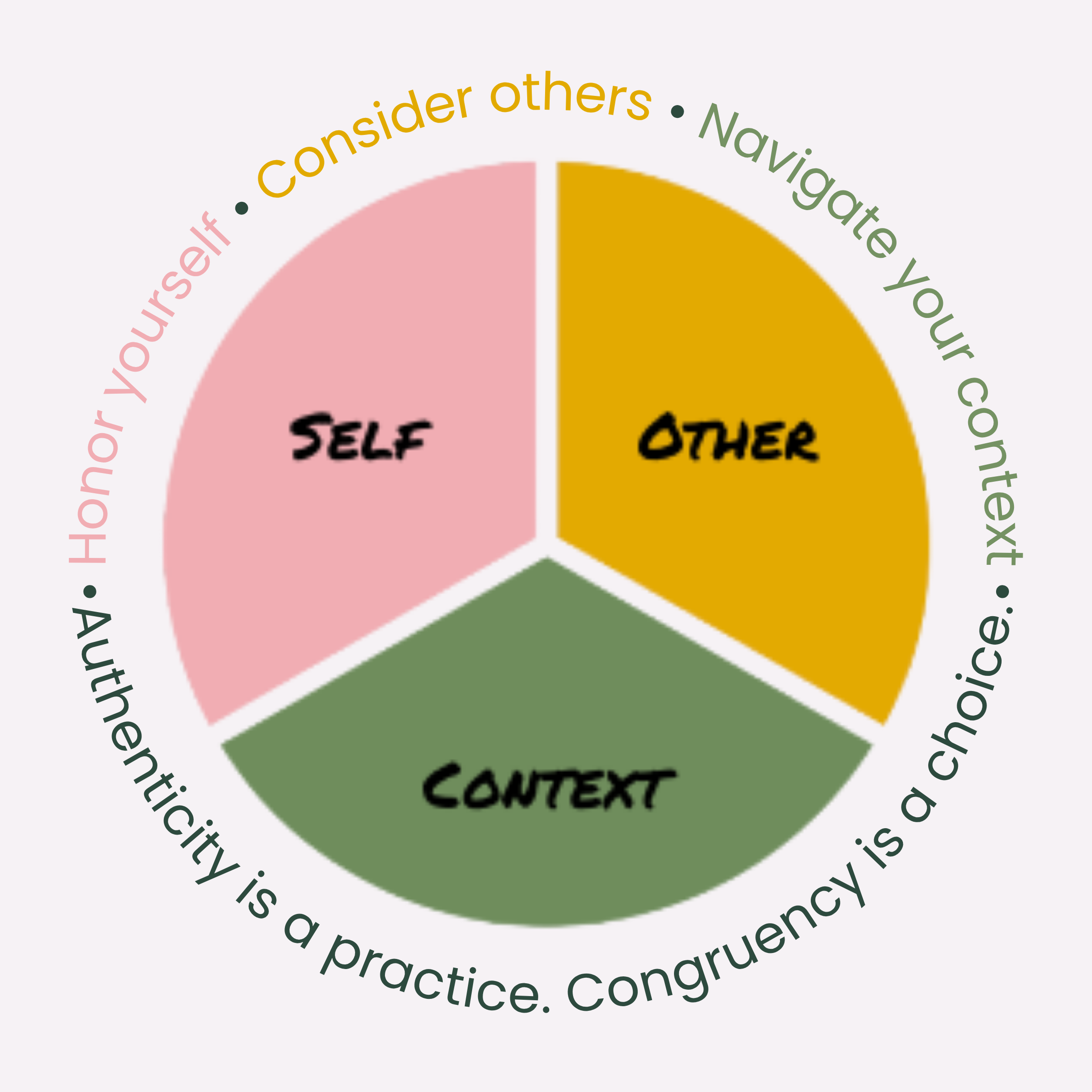
At the heart of Congruent Soul Therapy is the relationship between three interconnected elements: Self, Other, and Context.
We don't exist in isolation. Our thoughts, emotions, behaviors, and relationships are influenced by our histories, environments, and the people around us.
The Congruent Soul Framework helps us consider the whole picture.
SELF
What's happening within me?
Your thoughts, feelings, emotions, needs, values, beliefs, bodily experiences, and behaviors.
OTHER
What do I understand about the other person?
Their experiences, perspectives, communication, and behavior, while recognizing that we cannot know everything happening inside someone else's head.
CONTEXT
What else is influencing this situation?
Your history, relationships, environment, responsibilities, culture, and the circumstances surrounding your experiences.
This framework helps us move beyond simply asking, "What's wrong with me?"
We can begin asking better questions.
What have I learned? What am I responding to? What belongs to me? What belongs to someone else? What is happening in the environment around me?
Sometimes the issue isn't simply an individual pattern that needs to change. Sometimes the context deserves a closer look, too.
Therapy That Considers the Whole Picture
Neuroscience, relationships, and the experiences that shape us.

I'm Candice Coughenour, LMFT, founder of Congruent Soul Therapy.
My clinical approach is informed by neuroscience, Polyvagal Theory, relational and systems perspectives, and experiential exploration.
I'm particularly interested in how our brains, nervous systems, relationships, and environments interact to shape our experiences.
Why do certain situations feel threatening even when we logically know we're okay? Why can we understand a pattern intellectually but struggle to respond differently? How do early experiences influence the way we navigate relationships as adults?
These are the kinds of questions I enjoy exploring.
I believe there's value in understanding the science behind our experiences while also recognizing that people are much more complicated than a collection of symptoms or nervous system states.
Our work may involve exploring learned patterns, emotional responses, relational dynamics, protective adaptations, and the environments in which they developed.
There is room for curiosity, humor, creativity, and the occasional realization that something you've been doing for twenty years might actually have an explanation.
Therapy doesn't have to be stiff to be meaningful.
[Learn More About My Therapy Approach]
Services at Congruent Soul Therapy
Whether you're looking for individual support, relationship work, or a more focused therapeutic experience, there are different ways to work together.
Individual Therapy
Ongoing individual therapy for adults interested in understanding themselves, their relationships, and the patterns influencing their lives.
Couples Therapy
A space to explore communication, relationship dynamics, conflict, and connection together.
Therapy Intensives
A more concentrated therapeutic experience designed around specific goals and areas of focus.
Virtual Therapy in Pennsylvania & Georgia
Congruent Soul Therapy is a private-pay virtual therapy practice led by Candice Coughenour, LMFT.
I provide virtual therapy to eligible adults physically located in Pennsylvania and Georgia at the time of their sessions, consistent with applicable licensure and practice requirements.
With roots in Pittsburgh, Pennsylvania, and a meaningful professional history in Georgia, I bring experience across both communities to my virtual practice.
Looking for a therapist in your state?
Frequently Asked Questions
How do I know which specialty is right for me?
You don't have to know before starting therapy. Many concerns overlap, and you may recognize yourself in several areas. We can talk about what's happening and identify where you'd like to begin.
Do I need a diagnosis to start therapy?
No. You can seek therapy for anxiety, relationship difficulties, emotional exhaustion, people-pleasing, identity concerns, and other experiences without having a formal diagnosis.
Do you work with neurodivergent adults?
Yes. My professional experience includes working with neurodivergent adults navigating ADHD and autistic traits, masking, relationships, and other experiences. Therapy can focus on understanding your needs and developing strategies that make sense for your life. Diagnostic assessment is not advertised as part of this service.
Is your approach trauma-informed?
Yes. My approach considers how past experiences, relationships, and learned adaptations can influence present-day emotional and relational patterns. The specific approaches used depend on your needs and my clinical training and scope.
Do you incorporate neuroscience into therapy?
Neuroscience and nervous system-informed perspectives are important influences in my clinical work. My training includes Polyvagal Theory, and I consider how learning, emotional experiences, nervous system responses, and relationships interact.
Is therapy virtual?
Yes. Congruent Soul Therapy provides virtual services to eligible adults located in Pennsylvania and Georgia during sessions.
Do you accept insurance?
Congruent Soul Therapy is a private-pay practice. Please review the fees and insurance information for details about payment and potential out-of-network reimbursement.
You Don't Have to Figure It All Out Before You Reach Out.
Maybe you recognize yourself in one of these specialties. Maybe several resonate. Maybe you just know that something isn't working the way you'd like it to.
You don't need to arrive with a perfectly organized explanation or a five-step plan for changing your life.
You can show up curious, uncertain, overwhelmed, or somewhere in between.
I'd be happy to meet you, hear a little about what brings you to therapy, and see whether working together feels like a good fit.
Let's start with a Vibe Check.
Candice Coughenour, LMFT
Congruent Soul Therapy
Private-pay virtual therapy in Pennsylvania and Georgia.