
My Approach to Therapy
Online Therapy for Anxiety, Overthinking, Burnout & Relationship Patterns
You can understand yourself and still feel stuck.
Maybe you know why you overthink, why saying no feels uncomfortable, or why you keep putting everyone else first. But knowing where a pattern came from doesn't always make it easier to change.
I'm Candice Coughenour, a Licensed Marriage and Family Therapist offering online individual and couples therapy in Pennsylvania and Georgia, with Florida telehealth registration.
My approach is relational, experiential, and grounded in the belief that your patterns make sense in the context of your life.
Together, we'll explore what's happening beneath the surface, understand how your patterns show up in everyday life, and find new ways of responding that feel more aligned with who you are and what matters to you.
Book Your Free 15-Minute Vibe Check
No pressure to have it all figured out. Just a chance to see if we're a good fit.
My Approach:
Beyond Insight Into Real-Life Change
Many of the adults I work with are highly self-aware. They understand their anxiety, recognize their people-pleasing, and can explain why they struggle with boundaries.
But insight doesn't automatically create change.
Sometimes overthinking becomes a way to manage uncertainty. Sometimes keeping everyone happy feels safer than expressing what you need. Sometimes your body responds to a situation before you've had a chance to consider what you actually want to do.
In therapy, we slow things down enough to notice these patterns as they happen.
Together, we explore what you've learned, how your responses developed, and whether those patterns are still helping you. We make room for thoughts, feelings, bodily experiences, relationships, and the circumstances shaping your life.
The goal isn't to eliminate every uncomfortable feeling. It's to build more flexibility in how you respond.
The Clinical Perspectives That Inform My Work
Relational and Systems-Based
Your experiences don't happen in isolation. Family dynamics, relationships, culture, identity, and your environment all influence how you understand yourself and navigate the world.
We consider these influences without assuming that everything is your responsibility to fix.
Experiential and Present-Focused
We don't just talk about your patterns in hindsight. We pay attention to how they show up in the moment: what you think, what you feel, how your body responds, and what you do next.
This creates opportunities to practice new responses rather than relying on insight alone.
Nervous System-Aware
Anxiety, overthinking, and people-pleasing can become familiar ways of responding to uncertainty or relational stress.
We'll explore how these responses show up for you, what may be maintaining them, and how you can develop more flexibility in how you respond.
Non-Pathologizing
I believe difficult experiences deserve to be understood in context, not automatically treated as evidence that something is wrong with you.
Diagnosis can be helpful, but it doesn't define your whole experience. My focus is on understanding you as a person, including your history, relationships, needs, values, and goals.
As a private-pay therapist, I can focus our work on what brings you to therapy rather than making an insurance-driven diagnostic process the center of our work. When a diagnosis is clinically relevant, we can discuss it together.
Values-Aligned
I want therapy to help you make choices that reflect what matters to you, while recognizing the needs of others and the circumstances you're navigating.
This is where the Congruent Soul Framework comes in.
The Congruent Soul Framework
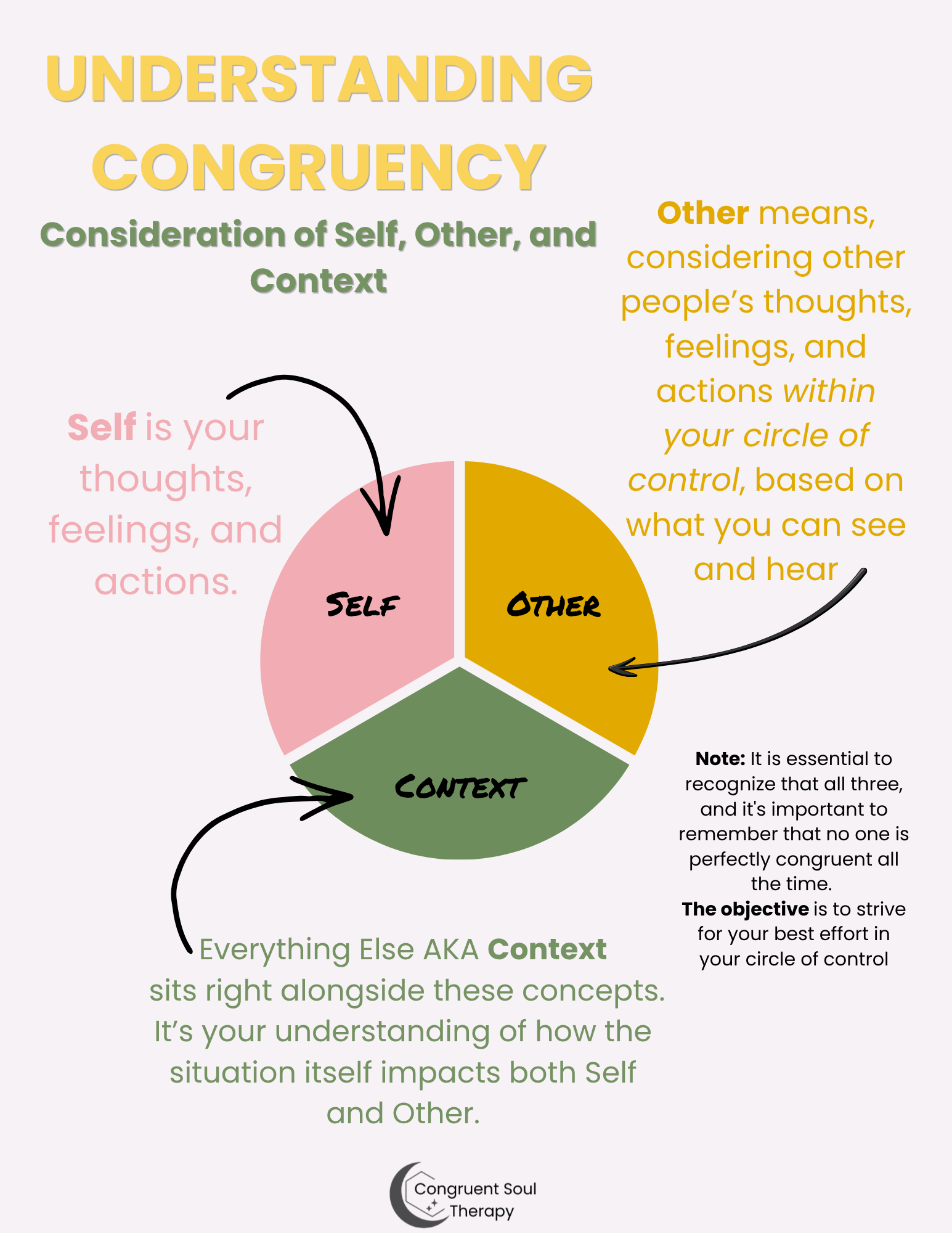
At the heart of my work is a simple idea: living congruently means considering yourself, other people, and the context you're in as you make choices that align with your core values.
I call this the Congruent Soul Framework.
The framework considers three interconnected elements:
Self: Your thoughts, feelings, and actions, and how they relate to your core values.
Other: What you understand about other people's thoughts, feelings, and actions through what they say and do.
Context: The circumstances and environment shaping what's happening for everyone involved.
Congruency isn't about getting every decision right, controlling other people, or keeping everyone happy.
It's about considering the whole picture, recognizing what is within your circle of control, and responding with greater awareness and intention.
Sometimes that means setting a boundary. Sometimes it means reconsidering an assumption, acknowledging a need, or recognizing that a situation is genuinely difficult.
The goal isn't perfection. It's a more honest relationship with yourself and the world around you.
Clinical Training & Professional Credentials
My clinical perspective is shaped by formal education, professional experience, specialized training, and ongoing learning.
Education & Credentials
Master of Arts in Marriage and Family Therapy — Seton Hill University
Bachelor of Arts in Art Therapy — Seton Hill University
Licensed Marriage and Family Therapist (LMFT) — Pennsylvania and Georgia
Florida telehealth registration
Reiki Certified Practitioner
Ordained Minister
Clinical Experience
My career began in intensive outpatient substance use recovery, where I learned the importance of safety, honesty, and compassion in the healing process.
I later worked with neurodivergent adults and supported clients navigating emotional exhaustion, anxiety, perfectionism, and people-pleasing. I also served as Clinical Director at a group practice.
These experiences continue to inform how I understand the relationship between individual experiences, relational patterns, and the environments in which people live.
Specialized Training & Ongoing Professional Development
My training and developing areas of focus include:
Experiential and systemic therapeutic models.
Brainspotting training.
Social anxiety.
Couples and relationship patterns.
Attachment and trauma-informed approaches.
Nervous system regulation and neuroscience-informed perspectives.
Holistic mental health.
I'm also pursuing additional professional development in polyvagal-informed work, trauma treatment, and holistic mental health.
As I continue this learning, I integrate relevant approaches thoughtfully and within the scope of my training and professional qualifications.

What This Means for You
You don't need to know which therapeutic approach you need before starting therapy.
We begin with your experience, your goals, and what feels most important right now.
Depending on what brings you to therapy, we may explore:
Anxiety and overthinking that make it difficult to switch off.
People-pleasing and boundaries that bring up guilt or fear.
Burnout from constantly being the capable one.
Relationship patterns that keep repeating.
Identity, self-trust, and reconnecting with your needs.
Stress responses that make it difficult to feel grounded and present.
Your therapy isn't a formula. The work is shaped around you, your circumstances, and what you're hoping to change.
Therapy Should Feel Human
*
Therapy Should Feel Human *
Expect real talk, honest reflection, gentle sarcasm, and room to be an actual human.
There is space for messy thoughts, uncomfortable questions, tears, humor, and the moments when something finally clicks.
You don't need to explain everything perfectly. You don't need to arrive with a complete plan. And you don't have to become someone else to make meaningful changes.
Therapy is an opportunity to understand yourself more deeply, relate to yourself and others differently, and create more possibilities for how you live.

Bringing It Together: The Congruent Soul Framework
Across these approaches, one idea remains central: understanding yourself within the context of your life.
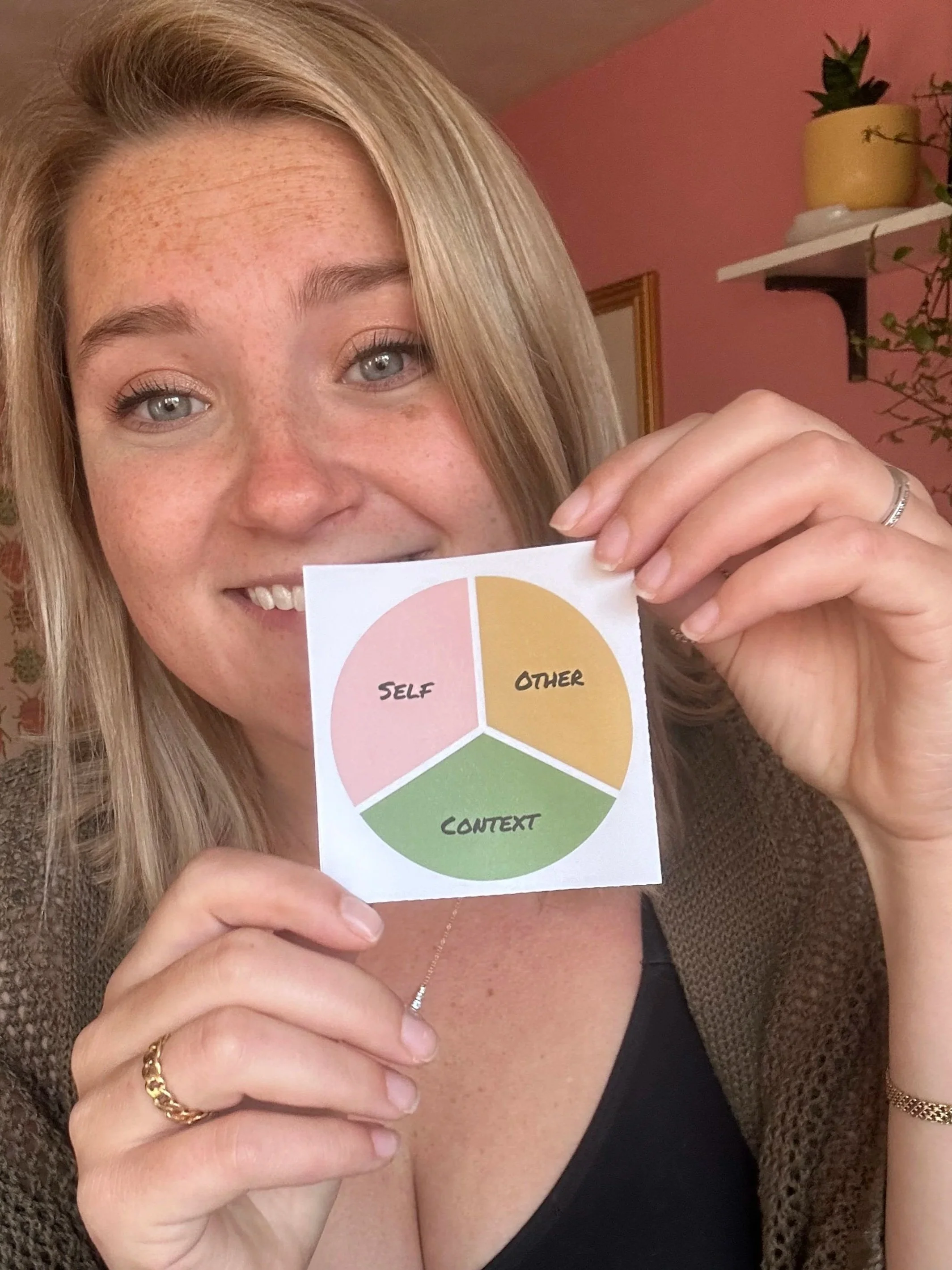
The Congruent Soul Framework considers Self, Other, and Context to help you make choices that align with your core values while taking into account the people and circumstances around you.
The goal isn't perfection or having every answer. It's building a more honest relationship with yourself and greater flexibility in how you respond to life's challenges.